


Teaching and Learning Lab for Informatics Education
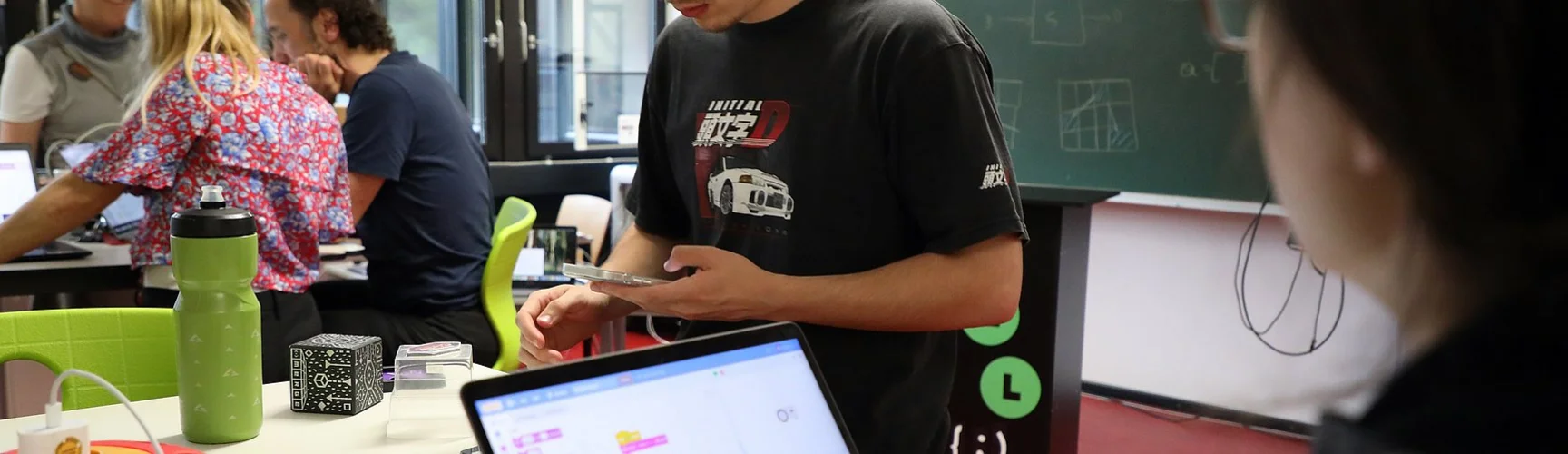
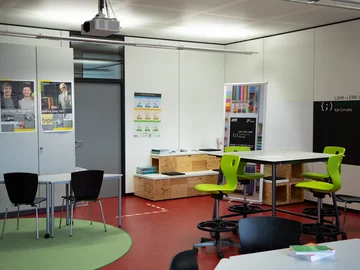
The Computer Science Teaching and Learning Laboratory is a learning centre offering activities for trainee teachers of computer science and school classes. It has two objectives: to integrate practical experience into the teacher training programme in computer science, and to promote computer science skills amongst pupils.
The concept is designed in such a way that, through the interplay of practical experience, research into this experience and collaborative work with KIT, the teaching and learning laboratory achieves a lasting impact on future computer science teacher trainees. As part of subject-specific teaching methodology courses, students can try out concepts from computer science in a practical setting directly at the university. This allows a practical focus to be integrated into teaching, thereby supporting the professional development of trainee computer science teachers.
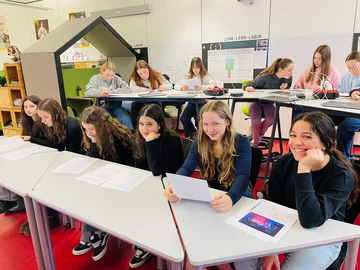
In addition to the laboratory activities as part of the computer science degree programme, our Teaching and Learning Laboratory also offers workshops for school classes. This not only gives pupils the opportunity to engage with computer science topics beyond the classroom; teachers also benefit from new teaching ideas and subject-specific input.
The Computer Science Teaching and Learning Laboratory at the University of Education is located in Building 2, Room B.112.
Do pop along to the OpenLab!
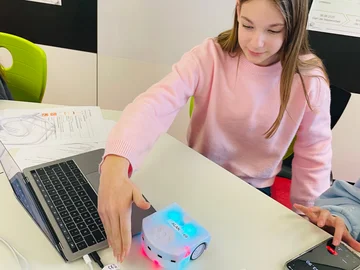
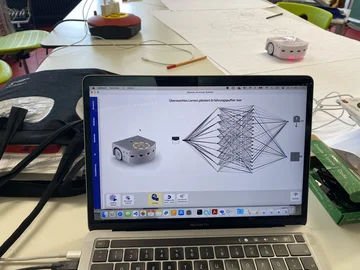
The Computer Science Teaching and Learning Lab organises an OpenLab every semester, giving students and teaching staff the opportunity to try out various gadgets (robots, VR headsets, microcontrollers, etc.) and ideas. The OpenLab is run by our student assistant, Simon Wenz.
In the winter term of 2026, the OpenLab will take place every Friday from 12:00 to 14:00 during term time.
No registration is required. We look forward to seeing you there!


Team
Organisation
Karlsruhe University of Education
Building
2
Room
B144
Phone
Availability
By arrangement
Student assistant
Institute of Computer Science and Digital Education
Student assistant
Institute of Computer Science and Digital Education
Alumnae
Dr Anette Bentz, MSc CS
Dr Frauke Ritter
The Computer Science Teaching and Learning Laboratory at the Karlsruhe University of Education, in collaboration with KIT, received funding from the Vector Foundation from autumn 2019 until the end of 2023.
Publications
Oser, A., & Standl, B. (2025). Teaching and Assessing Abstraction in K–12 Computational Thinking Education: A Systematic Literature Review. Computer Applications in Engineering Education, 33(5), https://doi.org/10.1002/cae.70073
Oser, A. (2025). Find One Solution that Solves both Problems! Algorithmic Problem-Solving with Equivalent Examples. In Proceedings of the 30th ACM Conference on Innovation and Technology in Computer Science Education, Vol. 2 (pp. 787–787). https://doi.org/10.1145/3724389.3730788
Ritter, F. and Standl, B. (2025). “Enhancing Algorithmic Thinking Through Semantic Waves: Integrating Necessity Learning Design in Computer Science Education,” 2025 IEEE Global Engineering Education Conference (EDUCON), London, United Kingdom, 2025, pp. 1–10 https://doi.org/10.1109/EDUCON62633.2025.11016370
Ritter, F. and Schlomske-Bodenstein, N. (2025). “Fostering Algorithmic Thinking within a Productive-Failure-Based Workshop Utilising AI,” 2025 IEEE Global Engineering Education Conference (EDUCON), London, United Kingdom, 2025, pp. 1–10, http://doi.org/10.1109/EDUCON62633.2025.11016641
Ritter, F. & Standl, B. (2024). “Semantic Waves: A Strategy for Algorithmic Skills in K-12 Computer Science Education”. 2024 IEEE Global Engineering Education Conference (EDUCON 2024) (pp. 1–10), Kos Island, Greece. https://doi.org/10.1109/EDUCON60312.2024.10578899
Bentz, A. & Standl, B. (2023). Beyond Gender Differences: Can Scratch Programmes Indicate Students’ Preferences?. In Proceedings of the 18th WiPSCE Conference on Primary and Secondary Computing Education Research (pp. 1–10). https://doi.org/10.1145/3605468.3609771
Bentz, A. & Standl, B. (2023). Novice Programmers’ Conceptions of Loops in K-12 Education in Consideration of Interest and Ability. In Proceedings of the 18th WiPSCE Conference on Primary and Secondary Computing Education Research (pp. 1–9). https://doi.org/10.1145/3605468.3605506
Ritter, F., Schlomske-Bodenstein, N., & Standl, B. (2023). Integration of an Informatics Teaching-Learning Laboratory into Pre-Service Informatics Teacher Education. Informatics in Schools. A step beyond digital education. 15th International Conference on Informatics in Schools: Situation, Evolution, and Perspectives (ISSEP 2022), Vienna, Austria. https://doi.org/10.5281/zenodo.7543522
Ritter, F., Bentz, A., & Standl, B. (2023). Promoting Algorithmic Thinking: Students Using mBots and Block-Based Programming. Practical Insights into Two Different Problem-Based Approaches. Informatics in Schools. A step beyond digital education. 15th International Conference on Informatics in Schools: Situation, Evolution, and Perspectives (ISSEP 2022), Vienna, Austria. https://doi.org/10.5281/zenodo.7543605
Bentz, A., Standl, B. (2022). Identification of pupils’ preferences for patterners and dramatists in secondary school computer science education. Discover Education 1(11). https://doi.org/10.1007/s44217-022-00011-0
Ritter, F., & Standl, B. (2022). Promoting Student Competencies in Informatics Education by Combining Semantic Waves and Algorithmic Thinking. Informatics in Education. https://doi.org/10.15388/infedu.2023.07
Ritter, F. & Standl, B. (2022). Promoting Computational Thinking in Teacher Education – Combining Semantic Waves and Algorithmic Thinking. In Proceedings of the 2022 ACM Conference on International Computing Education Research – Volume 2, ICER ’22. New York, NY, USA: Association for Computing Machinery. https://doi.org/10.1145/3501709.3544285
Bentz, A. and Standl, B. (2022). Dealing with Heterogeneity in the Computer Science Teaching and Learning Laboratory at the Karlsruhe University of Education. In 17th LeLa Annual Conference (LeLa 2022). Online.
Fragapane, V., & Standl, B. (2021). Work in Progress: Creative Coding and Computer Science Education – From Approach to Concept. 2021 IEEE Global Engineering Education Conference (EDUCON), 1233–1236. https://doi.org/10.1109/EDUCON46332.2021.9453951
Standl, B., Bentz, A., Ulbrich, M., Vielsack, A., & Wagner, I. (2020). Design and Evaluation Concept for Teaching and Learning Laboratories in Informatics Teacher Education. In K. Kori & M. Laanpere (Eds.), Informatics in Schools. Engaging Learners in Computational Thinking (ISSEP 2020) (Vol. 12518, pp. 133–145). Springer International Publishing. https://doi.org/10.1007/978-3-030-63212-0_11
Bentz, A., & Standl, B. (2020). Preliminary Experiences Towards an Inclusion of Dramatists—Teach Logic with Language (short paper). In K. Kori & M. Laanpere (Eds.), Proceedings of the International Conference on Informatics in School: Situation, Evaluation and Perspectives (ISSEP 2020) (Vol. 2755, pp. 171–175). CEUR-WS.org. http://ceur-ws.org/Vol-2755/shortpaper4.pdf
Updated on 28 October 2026 by Central Web Editorial Office