International Exchange Students


Are you interested in spending an exchange semester or a whole year at our university? We look forward to welcoming you! On this page, you’ll find everything you need to know.

Hello, I’m Lidiia from the International Office. Together with my colleagues Ana Paula Klein and Julia Friedl, we’ll explain everything you need to do so that we can welcome you to our university. We refer to our exchange students simply as ‘incomings’ – we prefer that to the rather cumbersome German term.

Lidiia Taranova International Office

Organisation

Karlsruhe University of Education

Building

3

Room

117, 116

As part of our lecture programme, there are some interesting courses on offer. And to help you settle in quickly in Karlsruhe and at our university, we provide personalised support and organise an exciting programme of activities during what is known as the ‘orientation month’.

Supporting programme


  • Free intensive German course lasting 6 weeks. To ensure you are prepared for the lecture term and can communicate with local people, we offer two different courses starting during the orientation month. Each semester, there is a course for beginners and one for advanced learners. The course content varies depending on the prior knowledge of our incoming students.
  • A varied and free programme of day trips and evening events organised by our International Club. The club organises cultural events, various city breaks and other activities throughout the semester. These events are a great opportunity to get to know the other international students and some local students. The International Club’s activities are organised by a group of students from our university. Of course, participation is not compulsory, and events take place in a relaxed and friendly atmosphere. You will receive the full programme for the International Club at the start of the orientation period.
  • Invitation to our Vice-Chancellor’s welcome reception.
  • One-day workshop on ‘Intercultural Competence’.

But first and foremost, of course, you’ll get to know your personal ‘buddy’.

Even before you arrive here with us, we’ll introduce you to your personal buddy. This is a student at our university who has volunteered to look after you during your first few days in Karlsruhe. You’ll be picked up from the station or bus stop and taken to your halls of residence. You’ll also receive support with your enrolment and other administrative matters. Buddies often become friends.

Lidiia Taranova International Office

Courses


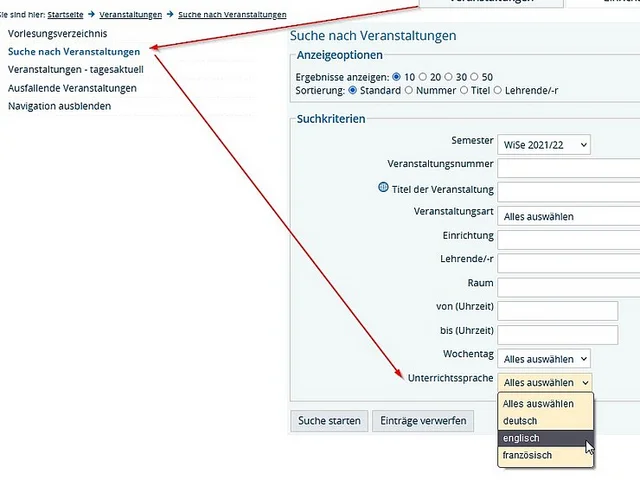
The range of courses on offer varies from semester to semester. You can view the current course catalogue online in our course catalogue on the LSF platform. Although the platform is in German, you can search for courses taught in English and French. Here’s how to use this search function:

If you’re planning to study here during the winter semester, take a look at the course catalogue for the previous winter semester; for the summer semester, check the one from the last summer semester. This will give you an overview of the courses we usually offer. You can choose courses from any subject – provided your home university agrees – regardless of the subject you are enrolled in. You can also attend most practical modules in the subjects of art, music or sport. Simply let us know in good time before the start of the semester.

In addition, you will have the opportunity to undertake a supervised work placement at a school in the Karlsruhe area during the semester. The work placement takes place one morning a week. As the number of work placement places is limited, you must let us know as soon as possible if you would like to undertake such a placement.

Lidiia Taranova International Office

Apply


Our incoming students choose to spend either a semester or a full academic year as visiting students at our university. The academic year consists of a winter and a summer semester. You can find the key dates in the table. Please take particular note of our orientation programme.

Hello, in order to receive the application documents for your application to our university, you must first be nominated by your home university. Please ensure that you apply for the exchange programme at your university in good time.

Paula Klein International Office

Dates and deadlines

 Winter termSummer term
Nominationby 15 Mayby 15 November
Applicationby 31 Mayby 30 November
Notification of acceptancemid-JuneMid-December
Orientation/Intensive language courseEarly September to mid-OctoberEarly March to early April
Lecture termMid-October to early FebruaryEarly April to late July
Exam perioduntil mid-Februaryuntil mid-August

Studying


In English

  • English-language lectures delivered by the Institute for Multilingualism, such as lectures on literature, linguistics, cultural studies, TEFL (‘Teaching English as a Foreign Language’) and didactics.
  • English-language modules from other departments, specially tailored to our incoming students.
  • Work placement at a German school.
  • Free German language courses for various levels of proficiency.

Please note that the vast majority of our lectures are held in German. The only exceptions are the lectures offered by the Institute for Multilingualism, which are delivered in either English or French.

Paula Klein International Office

In German

  • Modules from our Bachelor’s degree programmes in teacher training. These include, amongst other things, educational science, as well as the theory and methodology of various school subjects, and English or French as a foreign language.
  • Modules from other Bachelor’s or Master’s degree programmes, such as early years education or cultural mediation.
  • A teaching placement at a German school.
  • Further development of German language skills through advanced language courses during the semester.

A trial teaching session at a German school

On request, we can offer visiting students the opportunity to sit in on lessons at German primary or secondary schools and/or to teach in German or English. Teaching practice is supervised by a mentor and, upon successful completion of the placement, you will receive the corresponding credit points (CP).

Degree programmes and subjects

Grading system

German mark
 
German explanation
1.00 – 1.49
 
Very good (highest mark)
1.50 – 2.49Good
2.50 – 3.49Satisfactory
3.50 – 4.00Pass (lowest passing mark)
4.01 – 6.00Unsatisfactory
Pass (Pass)All required work has been completed;
no mark is awarded

Entry


Visiting students from many countries outside the EU generally need to apply for a visa before entering Germany. Please check with the relevant Embassy of the Federal Republic of Germany in your home country in good time.

Paula Klein International Office

Visiting students from the USA, Canada, Australia, New Zealand, Israel, Japan and South Korea can enter the country without a visa and, upon arrival here in Karlsruhe, will be issued with a residence permit for the duration of their studies.

Arrival


Once you arrive in Karlsruhe, you can look forward to the buddy programme and an intensive language course, as well as a wide range of leisure activities and excursions, to help you feel at home with us.

Accommodation

There are almost always vacancies for incoming students in the student halls of residence near the campus. There, you will have a single room and share a bathroom and kitchen with your flatmates. If you would prefer to find accommodation yourself, we recommend visiting the website of the Studierendenwerk Karlsruhe.

Course selection and enrolment

Before you leave, your home university will usually ask you to sign a learning agreement. However, it might be easier for you to choose your courses or modules once you have arrived here at our university, if your home university is willing to wait until then. The standard workload per semester is 30 ECTS credits. Please check with your home university to find out how many ECTS credits you are required to complete.

It is generally not necessary to register for courses or modules before you arrive!

Lidiia Taranova International Office

Europe sets an example


"Europa macht Schule" (EmS) is a programme designed to promote exchanges between young Europeans, run on a voluntary basis. Its aim is to bring the idea of European exchange to life and to encourage social engagement and political participation. In this way, all those involved experience Europe and its cultures first-hand and directly.

The programme is run by the German Academic Exchange Service (DAAD) and the voluntary association “Erasmus macht Schule e. V.”.

The programme invites visiting students from across Europe to take part in a project with a German school class. There, they can present their home country in a creative way: for example, by playing Gaelic football with the pupils, re-enacting the French presidential elections or giving the children a taste of a Turkish school day. The participating pupils are actively involved, in accordance with their age, in the planning, implementation and documentation of the project. The programme concludes with a closing ceremony at which all the projects from a particular city are presented to the public. In this way, the school pupils gain a concrete and vivid insight into a European country, whilst the students are immersed in a slice of German life outside the university. They interact with local people and feel like welcome guests.


The aim of this intercultural exchange is to make an active contribution to international understanding in Europe. Through the participation of European exchange students, everyone involved learns about the differences and similarities between neighbouring European countries. In this way, theoretical knowledge about cultures becomes ‘tangible’ in practice, and prejudices are broken down. You’ll become a mini-ambassador for your country by creatively showcasing its unique features in schools across Germany. This is what brings Europe to life!

Lidiia Taranova International Office

Updated on 1 October 2026 by Central Web Editorial Office