


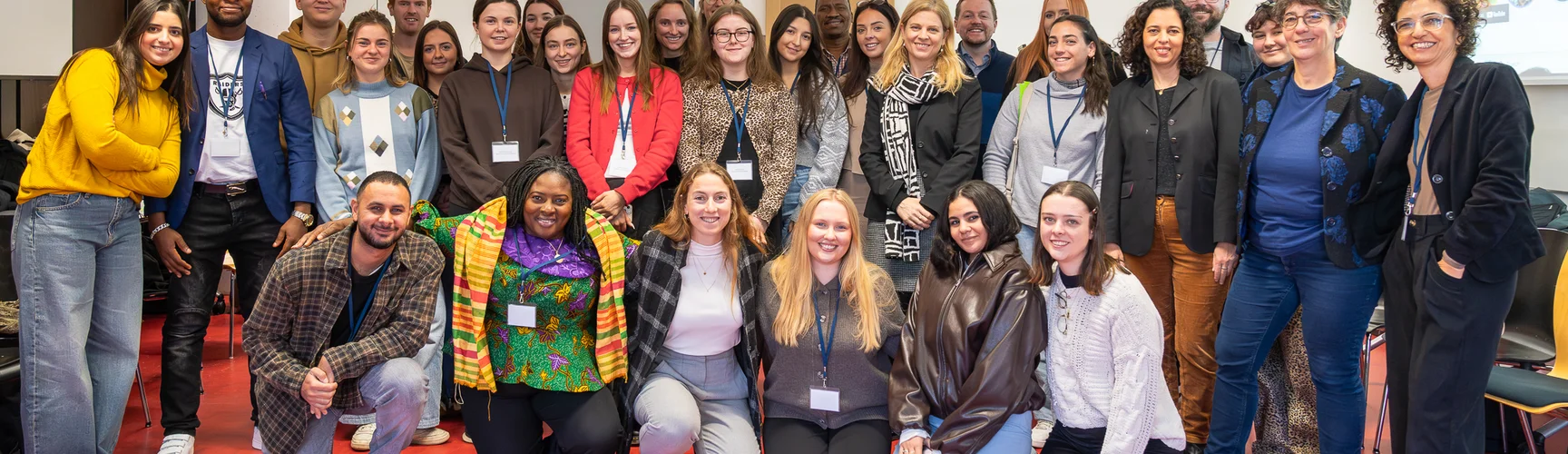
Global Teaching Conference 2027
From 4 to 7 October 2027, our university will host the international conference ‘Global Teaching – Conceptual, Empirical and Practical Perspectives for Teaching and Teacher Education in a Globalised World’. The focus will be on how (teacher) education can respond to global and societal challenges, with particular attention being paid to topics such as internationalisation, multilingualism, decoloniality, digital transformation, sustainability and democratic participation. The programme is aimed towards researchers and lecturers, as well as students and practitioners from schools, teacher education and civil society.
The main conference language is going to be English. However, we strive to make this a multilingual event as much as possible. Further information will be provided soon.
The main conference is currently scheduled for 4 to 6 October 2027 and will be followed by a programme for Early Career Researchers (including advanced Master's students potentially aiming to do a PhD, PhD students and Post-Docs in early career stages) from 6 to 7 October 2027.
Key thematic areas
The international conference ‘Global Teaching’ forms part of the ‘Get Ready for Global Teaching!’ project and focuses on the overarching question of how (teacher) education can respond to global societal challenges and what role internationalisation and global citizenship education can play in this regard. Particular emphasis is placed on the cross-cutting themes of the internationalisation of teacher education, decoloniality in teacher education and the curriculum, as well as diversity-sensitive, inclusive education in (post-)migration societies.
The conference’s key themes include, amongst others:
- Global Citizenship Education
- Democracy and Civic Education
- Diversity-sensitive, anti-discriminatory and inclusive education
- Education in post-migration societies
- Multilingualism and critical language awareness
- Digitalisation and AI in teacher training
- Internationalisation of teacher training, international mobility and international exchange
- Decolonial perspectives on teacher education and the decolonisation of the curriculum
- Peace education and ‘shared education’ in (post-)conflict societies
We will shortly be publishing further details on the conference’s key themes and content in our Call for Papers.
Call for Papers
The call for papers, containing further information, is expected to be published in December 2026.
Registration
Information on registration will be published here from spring 2027 onwards. Thanks to project funding, attendance at the conference will be free of charge. Some parts of the conference will be held in a hybrid format. Further details will follow.
Venue & How to get to Karlsruhe
Karlsruhe is a young, cosmopolitan city and home to important federal authorities such as the Federal Court of Justice and the Federal Constitutional Court. Above all, however, with nine universities, 26 research institutions and around 43,000 students, Karlsruhe is a city of science, education and research. Our university, situated in the heart of the city, plays an important part in this thanks to its focus on educational sciences, and we look forward to welcoming you to our campus.
In addition, Karlsruhe offers a wide range of cultural activities and attractions that you can visit during your stay.
Conference team
Organisation
Karlsruhe University of Education
Building
3
Room
225
Availability
By arrangement
Organisation
Karlsruhe University of Education
Building
3
Room
116
Phone
Availability
By arrangement
"Get Ready for Global Teaching!"
The “Get Ready for Global Teaching!” project aims to offer prospective teachers learning opportunities to further develop their cultural and linguistic sensitivity, and – through direct international exchange – to reflect on key contemporary issues and challenges from a global perspective, as called for by the concept of Global Citizenship Education.
The aim is to train teachers to design educational processes within linguistically and culturally diverse groups in a way that is inclusive and sensitive to diversity and discrimination. International exchange and networking contribute to the further development of these skills through direct and personal experience.
Further information can be found on the project website.
The conference is being organised as part of the “Get Ready for Global Teaching!” project, which is funded from 1 January 2025 to 31 December 2029 under the DAAD funding programme “Lehramt.international 2.0: Internationalisation of Teacher Training at German Universities’ (Module A, pilot projects at German universities).

Updated on 6 November 2026 by Mirjam Hitzelberger