


Sustainability and Climate Protection
Climate protection and sustainability are issues of central importance at universities, as we, as a university, have a special responsibility and a role to play as a role model in society.
Through our buildings, energy consumption, transport and procurement, we generate significant greenhouse gas emissions, which we can specifically reduce.
At the same time, as a university, we shape the future of teachers, specialists and managers through research, teaching and training, thereby contributing to sustainable development in the long term. Through active climate action, we make a tangible contribution to national and international climate targets, reduce costs in the long term and strengthen our role as an innovative and forward-looking institution.
#What we can do: Joint campaign by Karlsruhe’s universities and the KEK
What can we do together to improve climate protection on campus? That is precisely what ‘#Watt wir können’ is all about – the joint energy-saving campaign run by the Karlsruhe Energy and Climate Protection Agency (KEK) and Karlsruhe’s higher education institutions (PHKA, HKA, DHBW Karlsruhe, HfG Karlsruhe, HfM Karlsruhe, and the Karlsruhe Academy of Fine Arts). We want to share ideas, try out new things and show what climate protection can look like in practice in everyday university life.
Whether it’s saving energy, travelling to university or our daily consumption – it’s often the little things that make a difference. Together, we want to discover opportunities, question our habits and put good ideas into practice. Because climate protection concerns us all – and together we can make a bigger difference!
Joint Climate Action Plan at HKA and PHKA
As part of the state initiative ‘Climate-Neutral Universities 2030’, we have been developing a joint, integrated energy and climate protection concept (EuKK) for Karlsruhe University of Applied Sciences (HKA) and our university (PHKA) since October 2025. Our two universities share a campus in Karlsruhe comprising 13 main buildings and 9 satellite sites and are therefore tackling this project in cooperation. The task involves analysing the current situation, drawing up a greenhouse gas inventory and identifying potential savings across various scenarios. Building on this, climate protection strategies and specific measures to reduce emissions across various areas of action will be developed. The concept development process is supported by external service providers. Furthermore, the development of long-term monitoring and sustainability strategies contributes significantly to the sustainable embedding of climate protection at both universities.
The involvement of internal and external stakeholders is essential for the successful development of the climate protection strategy. University members will be involved in various ways, for example in the baseline analysis as well as in the development of measures.
Suggestions for potential measures are very welcome. Please feel free to send your ideas to klimaschutz@ph-karlsruhe.de.
Promoting sustainability and shaping the future – in teaching and research
Our university takes responsibility for sustainable development and integrates this theme into our degree programmes and beyond. In this context, the concept of Education for Sustainable Development (ESD) plays a key role in enabling us, as multipliers, to impart the knowledge, skills and values needed to embed sustainability in educational processes and to drive change in schools and society.
Furthermore, we are guided by the United Nations’ 17 Sustainable Development Goals (SDGs).
Sustainability in public administration
The university administration also plays its part in conserving resources, saving energy and advancing climate protection. Through a range of measures and initiatives, we are gradually making university operations more sustainable:
- Generation of renewable energy via solar panels;
- Sustainable lighting concepts;
- Use of electric vehicles;
- Promoting cycling: cycling infrastructure, staff bicycles;
- Resource-efficient regulations for events and business travel;
- Participation in EnMa-HAW: a concept for automation-supported energy management at non-university higher education institutions in Baden-Württemberg;
- Participation in bwCAFM, a state-wide cooperation project involving non-university higher education institutions in Baden-Württemberg aimed at the standardised introduction of CAFM (Computer-Aided Facility Management) software
and much more besides.
Collaborative projects
-
 Find out more
A cycle-friendly campus
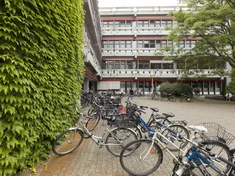
On the shared campus of PHKA and HKA, we are promoting cycling in a sustainable way. To this end, we are investing in a comprehensive network of secure bicycle parking facilities, additional service bikes (including cargo bikes) and a smart bike-sharing scheme, changing rooms for cyclists, as well as a permanent and a mobile bike repair workshop to serve as meeting places for everyone.
Contact
As Climate Protection Manager for the PHKA and HKA, Katrin Stolle is responsible for developing the joint integrated climate protection strategy.
Sascha Meyer, as Head of Facilities Management, is also the point of contact for climate protection issues.
Organisation
Karlsruhe University of Education
Availability
By arrangement
We also have two points of contact for sustainability matters – our sustainability officers
Organisation
Karlsruhe University of Education
Building
4
Room
410
Phone
Availability
Consultation hours during the lecture period in the summer semester: Wednesdays, 11.00 am – 1.00 pm.
Appointments for both in-person and online sessions can be booked via Stud.IP.
Online consultation hours are held as part of the Stud.IP course ‘Online Meetings – Birgit Neuer’.
Organisation
Karlsruhe University of Education
Building
2
Room
B310
Phone
Availability
By arrangement
Updated on 5 November 2026 by Kordula Manegold