


makeScience! Teaching and Learning Lab
The ‘makeScience!’ project acts as an extracurricular partner for schools, enabling them to explore topics relevant to the school curriculum in greater depth through experimentation.
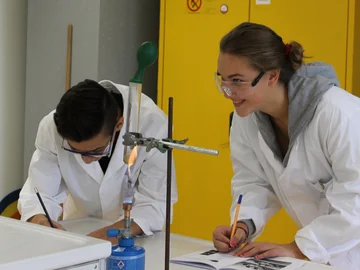
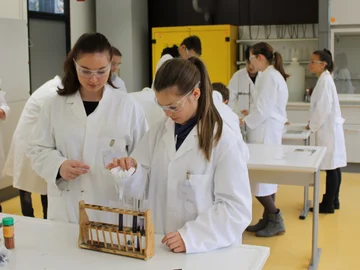
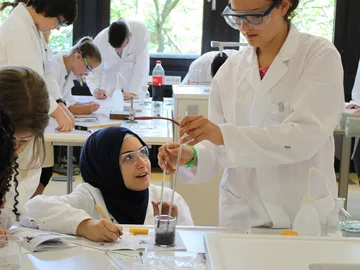
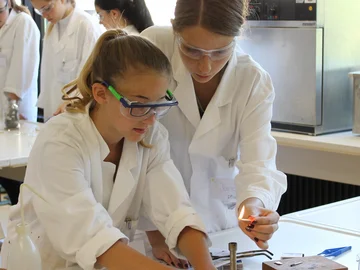
Supervisory duties in the teaching and learning laboratory are primarily carried out by students who have been trained to deliver a basic education in science and technology to a high standard. Before taking on supervisory roles within the project, students first attend specialised preparatory sessions to prepare them for their duties in the laboratory. This creates a centre for teacher training that fulfils the curriculum-based integration of teaching, research and practice.
Laboratory courses for lower secondary level
Years 6 and 7
Investigating and improving water quality
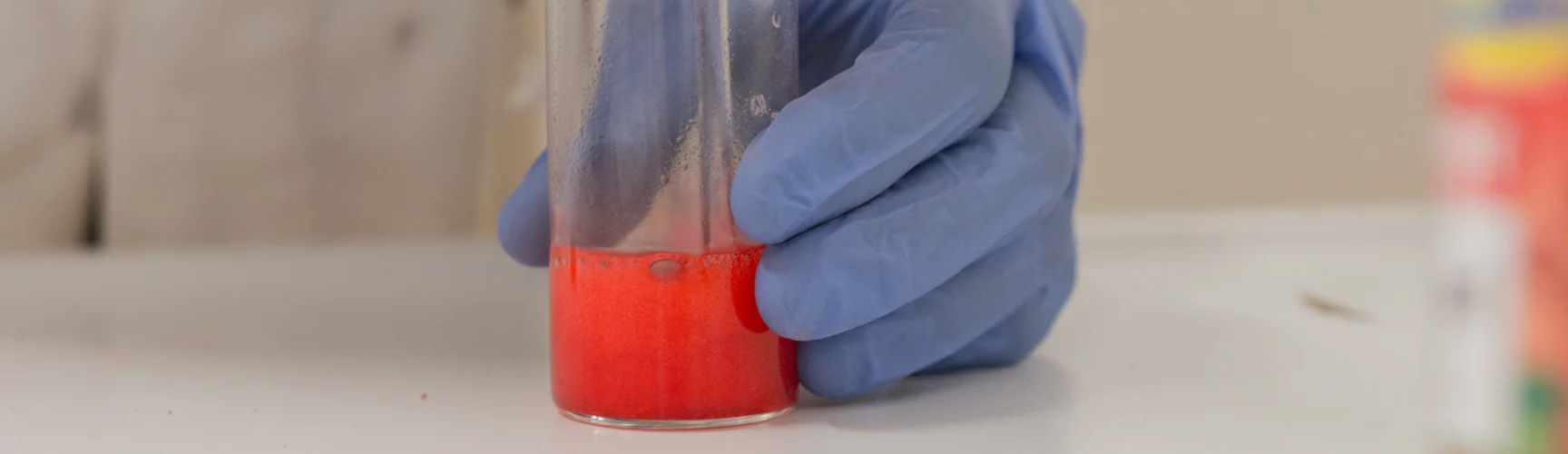
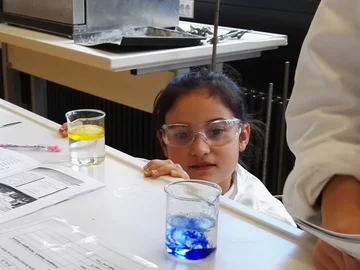
Here, pupils in Years 6 and 7 are carrying out experiments on the topic of ‘Water – Water Purification’. The chemical principles underlying substance separation, solubility and the analysis of different types of water – such as drinking water, river water and mineral water – are directly linked to practical experiments that address real-world environmental and sustainability issues.
Years 8 and 9
Protecting and preserving metal objects
In this programme, young people investigate the conditions under which metals rust and gain a basic understanding of how corrosion occurs. Through hands-on experiments, they recognise the importance of water, oxygen and salts in the corrosion process and observe how these factors affect metals. The insights gained can be directly applied to examples from everyday life and technology. In this way, pupils develop a sound understanding of how metals can be effectively protected and preserved in the long term – knowledge that is of great importance both for everyday life and for technical applications.
Year 10
Bioplastics for a sustainable future
The ‘Bioplastics’ school laboratory programme provides young people with a basic understanding of the structure and properties of various plastics, as well as sustainable alternatives made from renewable raw materials.
Pupils investigate different plastics in terms of strength, elasticity, solubility and durability, and compare conventional materials with bio-based and biodegradable alternatives. Another key focus is the production of simple bioplastics, during which the young people experiment with raw materials such as starch or milk proteins and analyse the resulting material properties.
Contact and Registration
Organisation
Karlsruhe University of Education
Building
2
Room
A200
Phone
Availability
By arrangement
Updated on 28 October 2026 by Uta Beck