


Ecological Teaching and Learning Garden
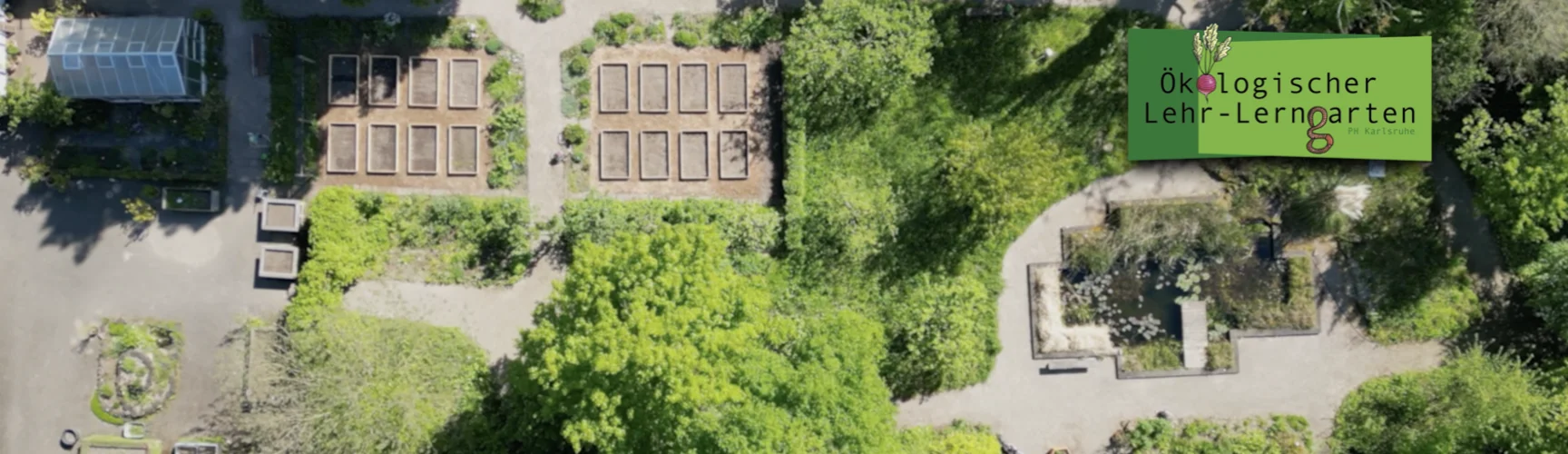
Our university’s Ecological Teaching and Learning Garden (ÖLLG) is available for outdoor teaching. It forms an integral part of the university’s biology teaching programme and serves as an authentic setting for courses. Depending on the course’s objectives, the ÖLLG fulfils different functions, for example as a space for hands-on experience, an educational garden or a productive garden. The garden is also open to visitors.
A Profile of the ÖLLG
The Ecological Teaching and Learning Garden was founded in 1985 and, following a move in 2009 to its current location on Adenauerring, was expanded to cover an area of 9,000 m². Based on Trommer’s (1994) concept of natural spaces, three areas were created: urban nature, with the guiding principle “Do something(!)”; cultural landscape, with the guiding principle “Care(!)”; and wilderness, with the guiding principle “Don’t do anything(!)”.
The following video provides an insight into the Ecological Teaching and Learning Garden. You can find further up-to-date impressions and interesting facts about the school garden on our Instagram account @lehr_lerngarten.phka or in our entry in the English-language Urban Nature Atlas.
Opening hours and garden rules
The ÖLLG is open to the public at the following times:
- April to July: Mondays from 8:00 am to 1:00 pm
- August to September: Mondays from 8:00 am to 12:00 pm
The ÖLLG is a campus garden created for the education of students and designed in collaboration with them. We
ask visitors to be considerate of the classes currently taking place.
Our garden rules apply.
Plan and Concept
| Design Concept | From urban nature (partially sealed, individual built elements) through to near-natural design (utility and sensory gardens) and ‘wilderness’ (biotope and succession areas). |
|---|---|
| Educational Concept | Joint design, maintenance and further development of the garden by students and teaching staff, combining practical gardening work with subject-specific and educational content. |
| Elements of the ÖLLG | Raised beds, compost, wild shrubs bearing edible fruit, herb spiral, herb garden, topiary hedges, stone oven, vegetable beds, perennial borders, greenhouse, tool shed, spindle fruit trees, sensory garden, ornamental shrubs, display beds for edible wild plants, orchard meadow, dry biotope, pond, stream, perennial mound, landscape hedges, Central European deciduous forest with native early-flowering plants, nesting aids, honey bees, garden shed with teaching and learning materials, outdoor teaching area (pergola). |
| Partnerships | Baden-Württemberg State Working Group for School Gardens (LAGS), Federal Working Group for School Gardens (BAGS), City of Karlsruhe (Horticultural Office), Botanical Garden of the Karlsruhe Institute of Technology (KIT), Heidelberg and Weingarten Universities of Education. |
| Awards | University Teaching Award from the University of Education, Karlsruhe, 2017 (ÖLLG team), UN Decade of Biodiversity Project 2016 and 2018, ‘Nature in the Garden’ plaque 2023. |
Study and Teaching
The ÖLLG is a facility run by the Institute for Biology and School Garden Development. Here, we offer courses as part of teacher training programmes in biology, as well as in other subjects.
Here, students learn through their own experiences and hands-on activities. They design, sow, tend and harvest under the guidance of their tutors. Through hands-on activities, students develop an interest in biodiversity and begin to ask questions about the phenomena they observe. Over the course of a gardening year, participants learn how to garden sustainably, and how school and other educational gardens can be designed, organised and meaningfully integrated into lessons.
The projects take place regularly during the summer term. As the gardening year cannot be precisely synchronised with the term dates, sessions are held from the end of January through to November, in which students from the respective summer term take part. In this way, participants experience a full gardening year with all its seasonal aspects.
The team
Management
Organisation
Karlsruhe University of Education
Building
2
Room
B207
Phone
Availability
By arrangement
Teaching staff and horticultural/technical staff
Organisation
Karlsruhe University of Education
Building
2
Room
B209
Phone
Availability
Consultation hours: Please arrange by email or register via StudIP
Organisation
Karlsruhe University of Education
Building
2
Room
B201
Phone
Availability
Tuesday 10:00–11:30 am
and by arrangement
Organisation
Karlsruhe University of Education
Availability
By arrangement
Organisation
Karlsruhe University of Education
Building
2
Room
A305
Phone
Availability
By arrangement
The Road to the ÖLLG
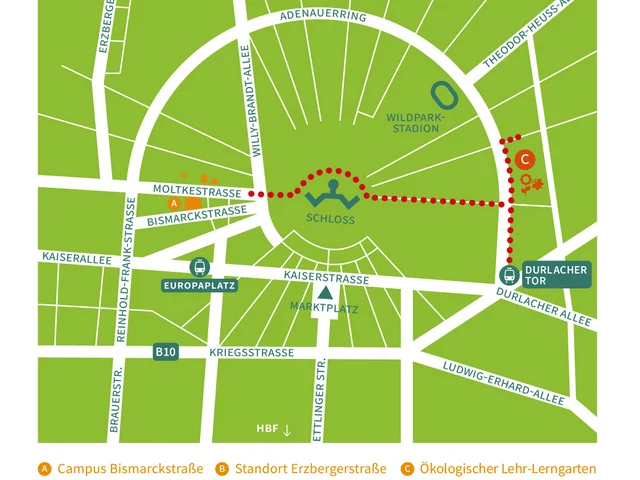
By bike or on foot: from the University of Education, take Moltkestraße towards the castle, go straight through the castle grounds to Adenauerring (East), then turn left after about 180 metres (at the traffic lights), and from there turn right into the cul-de-sac.
By public transport: get off at the Durlacher Tor stop, then walk along Adenauerring for about 500 metres northwards. Cross the road “Am Fasanengarten” and, after a further 180 metres (alongside the educational garden), turn right (at the traffic lights) into the cul-de-sac.
By car: Access via Adenauerring; parking is available in the KIT forest car park, Campus South. Address for sat-navs: Waldparkplatz, Adenauerring 20, 76131 Karlsruhe.
Publications
on the school garden run by the institute
Lehnert, H.-J., Köhler, K., & Benkowitz, D. (2026). School Gardens – Creating, Maintaining and Using Them (2nd ed.). Ulmer.
Benkowitz, D. & Max, AL. (2026). Digital Tools to Study Biodiversity in School Gardens. In: Jarau, S., Benkowitz, D. (eds) Sustainability Education in School Garden-Based Learning. International Explorations in Outdoor and Environmental Education, vol. 18. Springer, Cham. https://doi.org/10.1007/978-3-032-10273-7_18
Jarau, S., & Benkowitz, D. (eds.). (2026). Sustainability Education in School Garden-Based Learning: Biological and Cultural Diversity (Vol. 18). Springer Nature Switzerland. https://doi.org/10.1007/978-3-032-10273-7
Benkowitz, D. (2026). School gardens as places for education for the future. In A. Carrapatoso, S. Kenner, C. Bergmüller-Hauptmann, N. Inkermann, & V. Reinhardt (Eds.), Handbook of Education for Sustainable Development (pp. 454–459). utb Volume No. 6380.
Benkowitz, D. & Weitzel, H. (2026). Save the Yellow-Bellied Toad (Bombina variegata)—The Impact of a Conservation Programme on Students’ Motivation and Relationship to Nature. In: Morin, O., Bruguière, C., Hammann, M. (eds) Challenges of a Changing World in Biology Education. Contributions from Biology Education Research. Springer, Cham.
Benkowitz, D. (2023): School gardens as places of learning for ESD – opportunities and limitations. In Lang-Wojtasik, G., König, S. (eds.) The Great Transformation and Education for Sustainable Development. Weingarten Dialogue on Research 6. Ulm: Klemm & Oelschläger, 101–114.
Benkowitz, D., Retzlaff-Fürst, C. (eds.) (2023). The School Garden as a Place of Learning for ESD. Biology Teaching 483
Benkowitz, D., Retzlaff-Fürst, C. (eds.) (2023). Sustainability in the School Garden. Biology Teaching Compact 484
Hellinger, F., Benkowitz, D., Lindemann-Matthies, P. (2022): Do Radishes and Carrots Grow in a Bunch? Students’ Knowledge about the Growth of Food Plants and Their Ideas of a School Garden Design. Education Science 2022, 12(5), 299; https://doi.org/10.3390/educsci12050299
Benkowitz, D., Köhler, K. (2019). Learning in the school garden – is existing potential being utilised? http://nbn-resolving.de/urn:nbn:de:bsz:751-opus4-1855
Lindemann-Matthies, P., Köhler, K. (2019). Naturalised versus traditional school grounds: which elements do pupils prefer and for what reasons? Urban Forestry & Urban Greening, Vol. 46.
Benkowitz, D., Schulz, S., Lindemann-Matthies, P. (2018). The Impact of Gardening Experiences on Children’s Intake of Vegetables. Journal of Health, Environment and Education (11), 1–5. https://doi.org/10.18455/19001
Wenzel, D., Benkowitz, D., Köhler, K., Lehnert, H.-J. (2017): School Garden and Slow Mobil: Planning, Implementation and Evaluation of a Project on Healthy Eating. In: GDSU Journal 7(7): pp. 93–103. http://www.gdsu.de/gdsu/wp-content/uploads/2017/10/7_Wenzel-Benkowitz-Köhler-Lehnert.pdf
Benkowitz, D., Köhler, K. (2016): Access to nature right on the school doorstep. School gardens offer many benefits in terms of experiencing nature. In: Green Care 3 (2): 14–16.
Benkowitz, D. (2014): The impact of school garden experiences on primary school children’s perception of plant biodiversity. Schneider Hohengehren, Baltmannsweiler.
Köhler, K., Benkowitz, D. (2014): Supporting Awareness of Urban Biodiversity: School Garden, Schoolyard and School Surroundings. In: Kabisch, N., Larondelle, N., Reeve, N., Artmann, M. (eds.): Human-Environmental Interactions in Cities. Cambridge Scholars Publishing, Newcastle upon Tyne, UK: 100–114.
Ministry for Rural Affairs and Consumer Protection, Ministry of Education, Youth and Sport (eds.) (2012): Environmental Education and Sustainability. Interdisciplinary Work in the School Garden. Issue 1. MLR/MKS, Stuttgart. https://mlr.baden-wuerttemberg.de/fileadmin/redaktion/m-mlr/intern/dateien/publikationen/Bro_Umwelterziehung_Heft1.pdf
Ministry of Rural Affairs and Consumer Protection, Ministry of Education, Youth and Sport (eds.) (2012): Environmental Education and Sustainability. Interdisciplinary Work in the School Garden. Issue 2. MLR/MKS, Stuttgart. https://mlr.baden-wuerttemberg.de/fileadmin/redaktion/m-mlr/intern/dateien/publikationen/Bro_Umwelterziehung_Heft2.pdf
Updated on 5 November 2026 by Dorothee Benkowitz